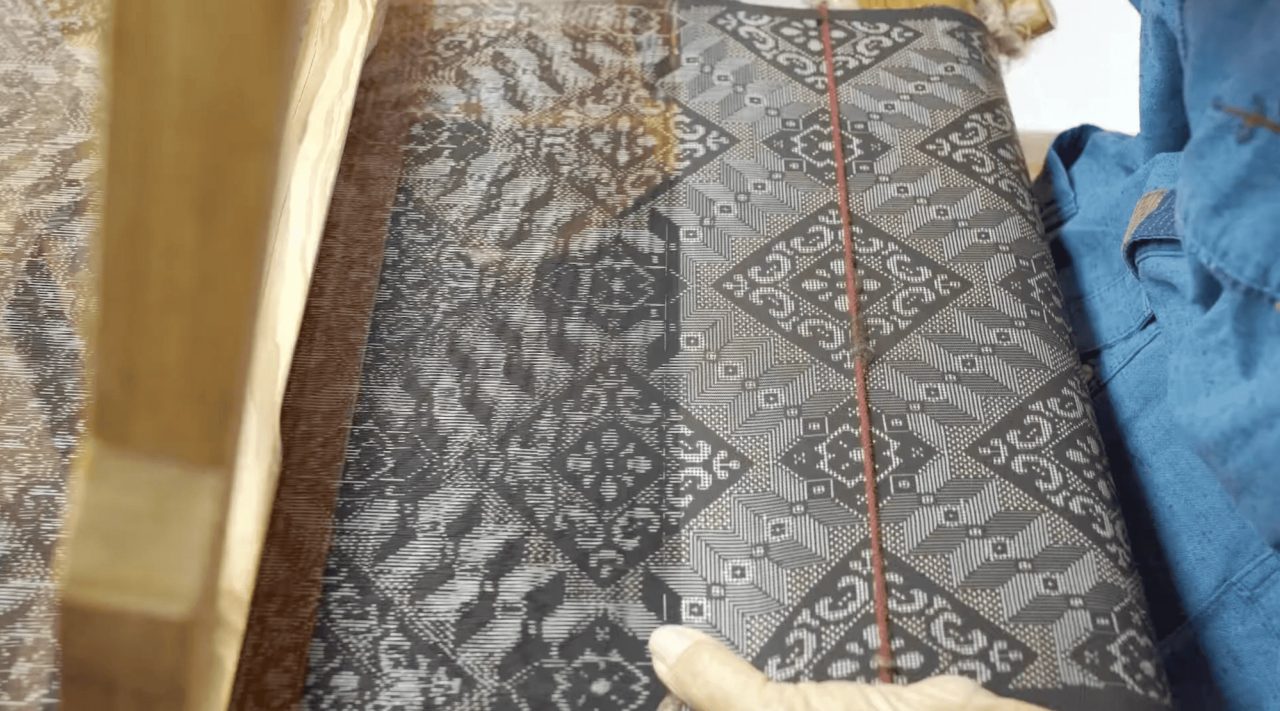
EP.77 · Honba Oshima Tsumugi · Kagoshima
One of Three World's Top 3 Textiles
Honba Oshima Tsumugi (本場大島紬) is Japan’s most celebrated silk textile, woven in Amami (奄美), Kagoshima.
Honba Oshima Tsumugi (本場大島紬) is Japan’s most celebrated silk textile, woven in Amami (奄美), Kagoshima. Its origins are debated, some trace it to the 7th century, others to Southeast Asian ikat. By the 18th century, it was so prized that the Satsuma clan restricted locals from wearing it, reserving it as tribute.
Unlike most textiles, Oshima Tsumugi is dyed before weaving. Designs are mapped, threads bundled, and pre-woven tightly on a special loom to resist dye, earning it the name “the textile woven twice.” The bundles are dyed in techi (テーチ) tree juice, then buried in iron-rich mud. Repeated up to 120 times, tannins and minerals react to create the deep black called the “wet crow’s feather.”
After dyeing, the bundles are undone and each thread rewoven by hand with microscopic precision. A kimono takes six months to a year, with even slight misalignments spoiling the design.
Today, it is regarded as the pinnacle of Japanese silk, ranked with Persian carpets and French Gobelins among the world’s top three textiles.

Craft Chronicles reaches people who care about how things are actually made.
Sources
- www.youtube.com/watch?v=fVBvz1x7ANU
- www.youtube.com/watch?v=5Yrxkr_08Sw
- www.youtube.com/watch?v=q6-gfH5vZkk
- www.youtube.com/watch?v=dGpXhcZBSDs
- oshimatsumugi.com/tsumugi/koutei/
- mikiooshima.com/until
- www.amaminosato.jp/tsumugi/
- amamioshimatsumugi.jp/fabrication-process/
- kougeihin.jp/craft/0125/
- kogeijapan.com/locale/ja_JP/honbaoshimatsumugi/
- story.nakagawa-masashichi.jp/craft_post/115675
- amamioshimatsumugi.jp/history/