EP.64 · Ise Katagami · Mie
The Art Behind a Thousand Kimonos
The use of stencils to dye fabric patterns has existed in Japan for over 1,400 years, but nowhere has it flourished more than in Mie Prefecture.
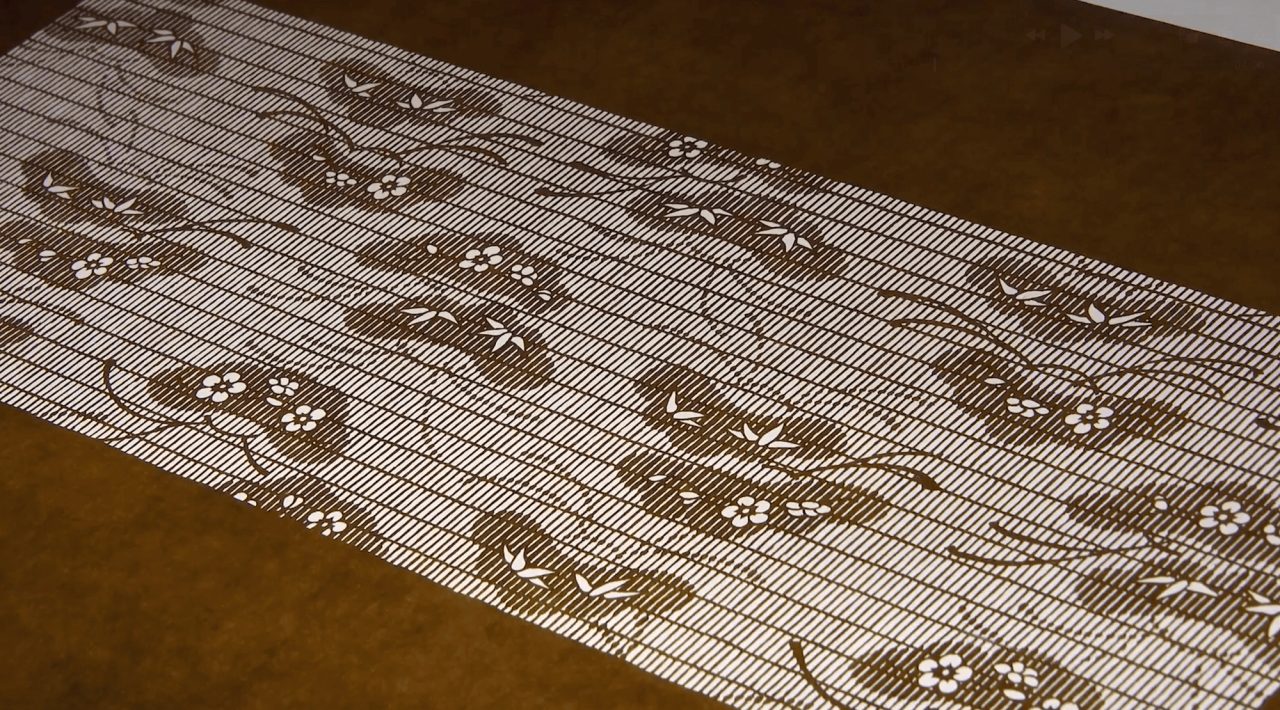
The use of stencils to dye fabric patterns has existed in Japan for over 1,400 years, but nowhere has it flourished more than in Mie Prefecture. Here, Ise Katagami (伊勢型紙) , made with layered Mino washi (美濃和紙) paper and strengthened with fermented persimmon tannin, are the most intricate of all stencils, forming the heart of Edo Komon (江戸小紋) , and many other patterned fabrics.
Most craftsmen dedicate their lives to mastering one of four techniques: shima-bori (縞掘り) for razor-fine stripes, dougu-bori (道具掘り) for intricate shapes, kiri-bori (錐掘り) for countless pin-sized holes, and tsuki-bori (突掘り) , the oldest method, for flowing freehand designs.
For each stencil, craftsmen forge custom blades, shaping and sharpening them specifically for that pattern. Using these tools, every cut must be exact. One mistake can ruin the entire piece, demanding nothing short of perfection.
Today, demand for kimono may have declined, but Ise Katagami is being reborn as framed artworks, architectural panels, and interior accents. No longer just tools for dyeing, these stencils now stand proudly as art in their own right, each carrying centuries of technique in every cut.
Craft Chronicles reaches people who care about how things are actually made.
Sources
- www.youtube.com/watch?v=lXcs6K0_Arw
- www.youtube.com/watch?v=WC05sw8x2PA
- www.youtube.com/watch?v=0yIBJQ7s2JM
- www.youtube.com/watch?v=GuJJ_Bgoa_I
- www.youtube.com/watch?v=kWpSqg5al0A
- www.youtube.com/watch?v=vYFsWb5bMIk
- www.youtube.com/watch?v=3vRgSITh8jQ
- www.osugi.co.jp/isekatagami.htm
- okoshi-katagami.com/techniques/
- kogeijapan.com/locale/ja_JP/isekatagami/
- kougeihin.jp/craft/1503/
- www.osugi.co.jp/kogaku/kogaku-turuwakamatu.htm
- hirosedyeworks.myshopify.com/en/collections/ties-ネクタイ/products/silk-tie-ikari-lime