EP.61 · Nibutani Ita · Hokkaido
Carving Ainu Spirit Into Wood
In the Saru River (沙流川) valley of Hokkaido lies Nibutani (二風谷), home to one of Japan's most unique woodcrafts: Nibutani Ita (二風谷イタ) .
In the Saru River (沙流川) valley of Hokkaido lies Nibutani (二風谷), home to one of Japan's most unique woodcrafts: Nibutani Ita (二風谷イタ) .
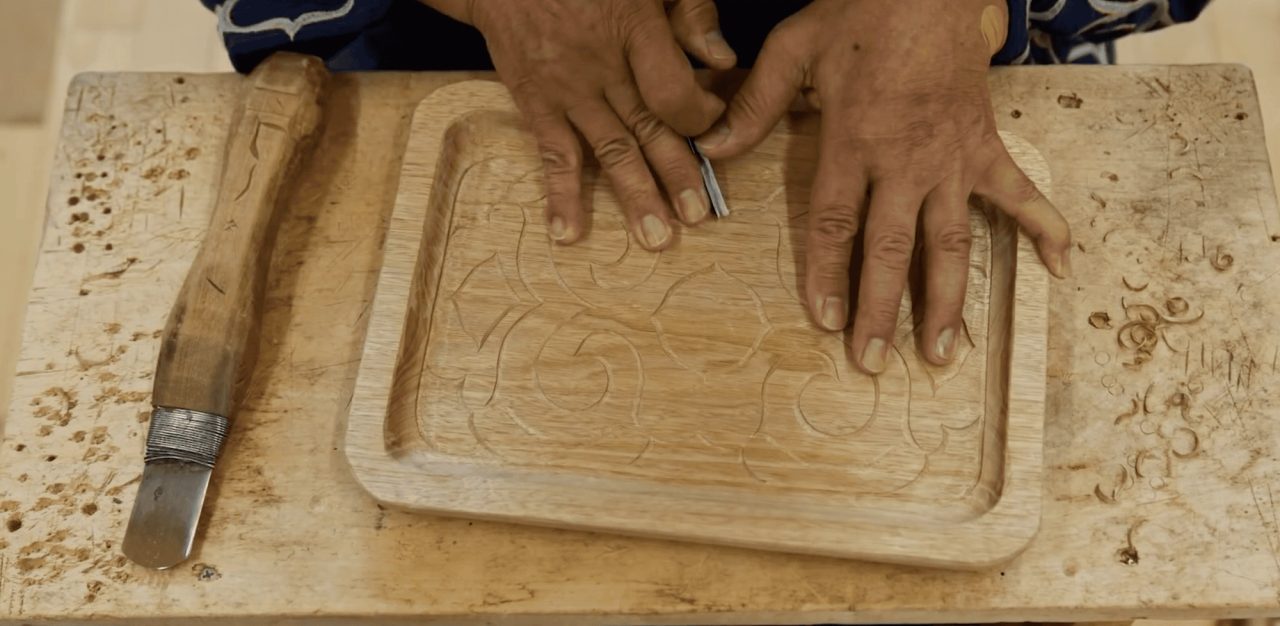
These flat platters, carved with Ainu patterns to ward off bad omens, have been passed down for generations. Originally carved using only the makiri (マキリ) , a small utility knife often decorated with carvings, these trays became symbols of skill and affection, with men gifting their creations or the makiri itself as tokens of love.
Each tray begins with walnut or katsura wood, dried for over three years. The artisan flattens the wood, sketches the design, and carves Ainu motifs such as Moreunoka (モレウノカ) spirals, Aiusinoka (アイウシノカ) thorns, Sikunoka (シクノカ) eyes, and the signature Ramuramunoka (ラムラムノカ) scales. These scales are hand-lifted to create depth and shimmer, filling gaps between motifs and giving each tray its distinct expression, echoing Ainu values and their bond with nature.
The Nibutani Ita, alongside Nibutani Attus fabrics, was officially recognized by Japan as a national traditional craft in 2013. With renewed interest in Ainu culture, thanks in part to the manga Golden Kamuy (ゴールデンカムイ), this tradition is now thriving more than ever.
Craft Chronicles reaches people who care about how things are actually made.
Sources
- www.youtube.com/watch?v=AOtUDShQ4hM
- www.youtube.com/watch?v=I8QVImuiCEc
- www.youtube.com/watch?v=IWytxuxO7Vk
- www.youtube.com/watch?v=oXmCc0j9GbA
- www.youtube.com/watch?v=weycClP4SzQ
- www.youtube.com/watch?v=zIpq42FxbsQ
- www.biratori-ainu-culture.com/craft/ita/
- www.nibutani-ainucraft.com/ita/
- kogeijapan.com/locale/ja_JP/nibutaniita/
- kai-hokkaido.com/archives/feature_vol46_nibutaniita/
- kougeihin.jp/craft/0601/
- www.jtco.or.jp/kougeihinkan/?act=detail&id=396&p=1&c=4
- artsandculture.google.com/asset/nibutani-ita-makiri-collection-of-nibutani-ainu-culture-museum-photo-toshihide-kajihara/DAGMXZMDmb1Jxg?hl=ja