EP.153 · Echizen Shikki · Fukui
Echizen Shikki: The Lacquerware that Feeds Japan
Echizen Shikki is a 1,500-year-old Japanese lacquerware craft from Fukui Prefecture. Renowned for its hana-nuri finish, it blends historic royal origins with modern tableware innovation.
Echizen Shikki, or Echizen lacquerware, is said to have begun around 1,500 years ago when a local artisan repaired the damaged crown of Prince Keitai, who later became Japan’s 26th emperor. After restoring the crown with lacquer, the artisan presented him with black-lacquered bowls.
Impressed by the craftsmanship, the prince encouraged the people of Katayama, now part of Sabae in Fukui Prefecture, to produce lacquerware.
The surrounding region provided ideal conditions for the craft to flourish. Its mountains supplied timber, while generations of urushi-kaki, or lacquer-tree sap collectors, developed specialized knowledge of this precious material.
By the Muromachi period, Katayama bowls were widely used during Hōonkō, an important Buddhist memorial service in the Jōdo Shinshū tradition. Echizen artisans later expanded their repertoire by learning chinkin from Wajima and maki-e from Kyoto.
Chinkin involves carving patterns into a lacquered surface and pressing gold leaf or powder into the incisions. In maki-e, designs are painted in lacquer and decorated with gold or silver powder.
Every piece, however, begins with its wooden form. Horse chestnut, mizume, and zelkova are dried and shaped on a lathe for bowls and other round objects, while trays and tiered boxes are assembled from carefully cut boards.
The surface is built up through repeated layers of foundation, lacquer, drying, and polishing. Each stage is handled by a specialist, including the woodturner, base-coating artisan, lacquerer, and decorator.
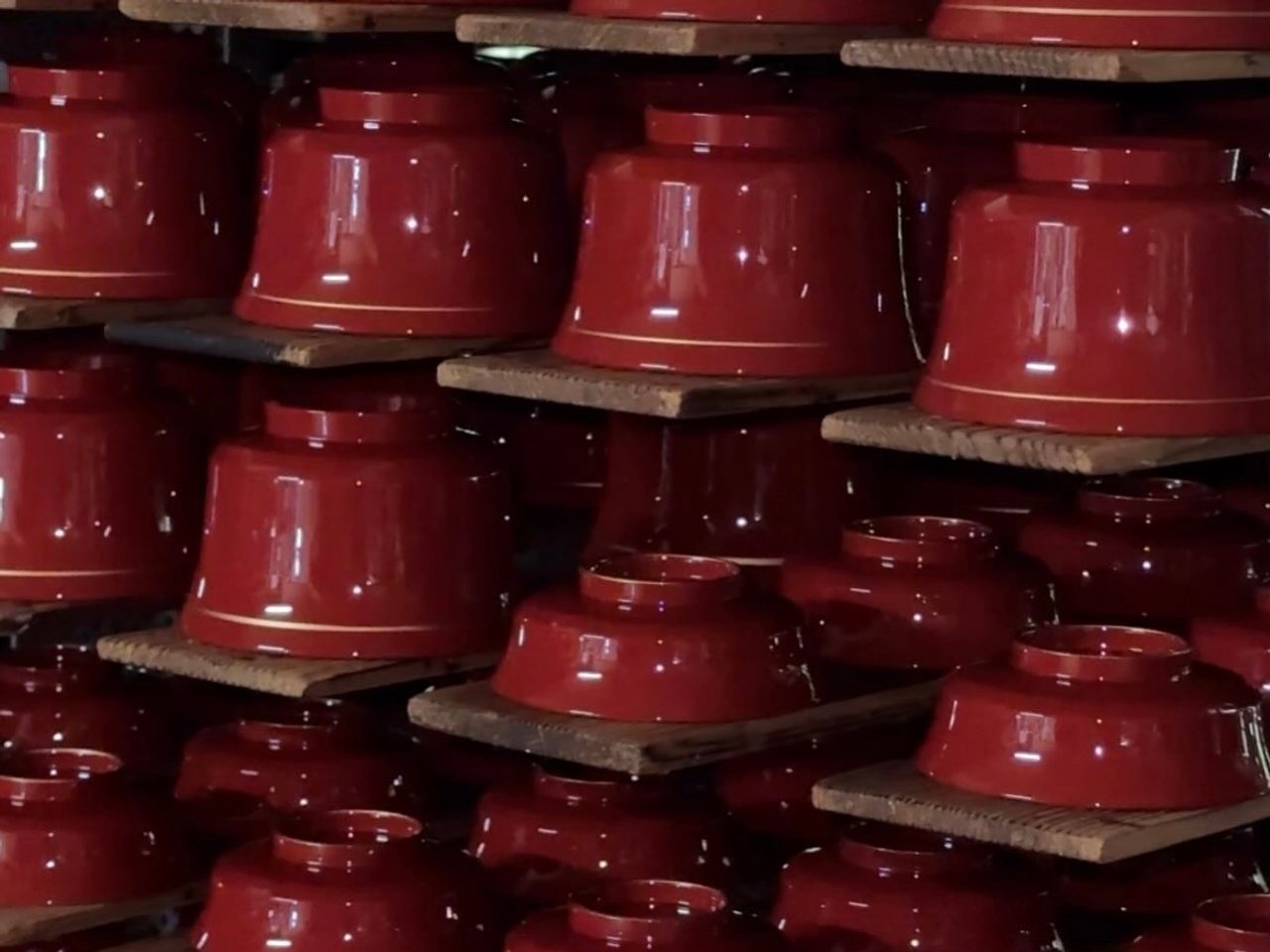
One of Echizen’s characteristic finishes is hana-nuri. The final coat of lacquer is applied so smoothly that it is left unpolished, preserving the rich sheen created by the brush itself.
This combination of specialized craftsmanship, durability, and adaptability allowed Echizen to grow beyond ceremonial bowls. The region became a major producer of lacquerware for hotels and restaurants while continuing to make traditional wooden pieces by hand.
Today, Echizen artisans create colorful tableware, contemporary designs, and even lacquered bowls suitable for dishwashers.
From a repaired crown to modern dining tables, Echizen Shikki has endured by allowing tradition to evolve with the way people live.
Craft Chronicles reaches people who care about how things are actually made.
Sources
- kogeijapan.com/locale/ja_JP/echizenshikki/
- story.nakagawa-masashichi.jp/craft_post/122213
- www.echizen.or.jp/echizenjapan
- kogei-japonica.com/media/crafts/echizen-shikki/
- www.city.sabae.fukui.jp/kosodate_kyoiku/manabenoyakata/bunkazai/sabae_bunkazai/mukeibunkazai/90-city.html
- 一般財団法人伝統的工芸品産業振興協会
- Artisan Zozo
- www.youtube.com/watch?v=mXHFKfwK4zQ
- www.youtube.com/watch?v=dj_hy50qK-Y
- www.youtube.com/watch?v=POixg4W_lPc
- www.youtube.com/watch?v=bQ-5LnxIYXk
- www.youtube.com/watch?v=ba0QBXv_lLU