EP.154 · Gakki Ito · Shiga
Gakki Ito: Silk that Made Japanese Sounds
In Kinomoto, Marusan Hashimoto hand-twists sericin-rich silk strings using traditional tops, preserving a centuries-old Japanese craft to deliver unmatched acoustic resonance for instruments.
The Last Workshop Twisting Silk Strings by Hand
One person runs about sixteen meters down the length of the workshop floor, stretching a thread of raw silk behind them.
At the other end, two people hold wooden paddles and spin a small weighted top against the thread, driving twist into it.
They work half-crouched. They have to move in time with each other or the string is ruined.
It takes about ten years to learn.
Seven companies in Japan still make strings for traditional instruments. Three of them work in silk. One still twists them with a spinning top.
What a machine does to the sound
The obvious question is why nobody has mechanized this, and the answer is not sentiment.
A machine can twist silk faster and tighter than three people running across a floor.
Tighter is the problem.
Over-twisted, the filaments pack down against each other and the sound comes out flat and closed in.
Twisted slowly by hand, small spaces of air stay trapped between the filaments. The sound leaves the instrument unevenly, spreading into the room rather than pushing in one direction, and it carries to the back of a concert hall.
Hidekazu Hashimoto, the fourth-generation head of Marusan Hashimoto in Kinomoto, Shiga, describes it as a sound that travels.
Nylon and polyester make the opposite trade. They are louder, they hold their pitch through Japanese summers, and they do not snap. They also flatten the overtones.
The fast Tsugaru shamisen playing style exists in the form it does partly because synthetic strings could survive it.
Neither material wins in the abstract. Silk is what professionals reach for when tone matters more than lifespan.
The silk is made for instruments, not for cloth
Before any of the twisting happens, the material itself has to be different.
Silk for weaving and silk for strings are not the same thread.
A string needs body and grip, and both come from sericin, the protein that coats raw silk filaments. A reeling method called namabiki keeps more of it.
Undried cocoons go into water heated to around 70 to 80 degrees, and the silk is drawn off at a far higher moisture content than textile silk, which gets dried down to roughly 42 percent.
That reeling still happens at the foot of Mount Shizugatake in northern Shiga, in the villages of Oto and Nishiyama, in snowmelt water.
Spring cocoons are used because spring silkworms carry more sericin. Local tradition puts the first reeling here in the Heian period, using spring water from Ikagu Shrine.
Until the mid-1950s, roughly seventy percent of the village worked in raw silk.
From there the thread passes through around twelve major stages on its way to becoming a string, nineteen if you count the small ones, and almost all of them are done by hand.
Filaments are gathered, knotted at set lengths, and combined five at a time.
Because raw silk is never uniform in thickness, the amount going into a single string is set by weight rather than by counting threads.
Then the twisting.
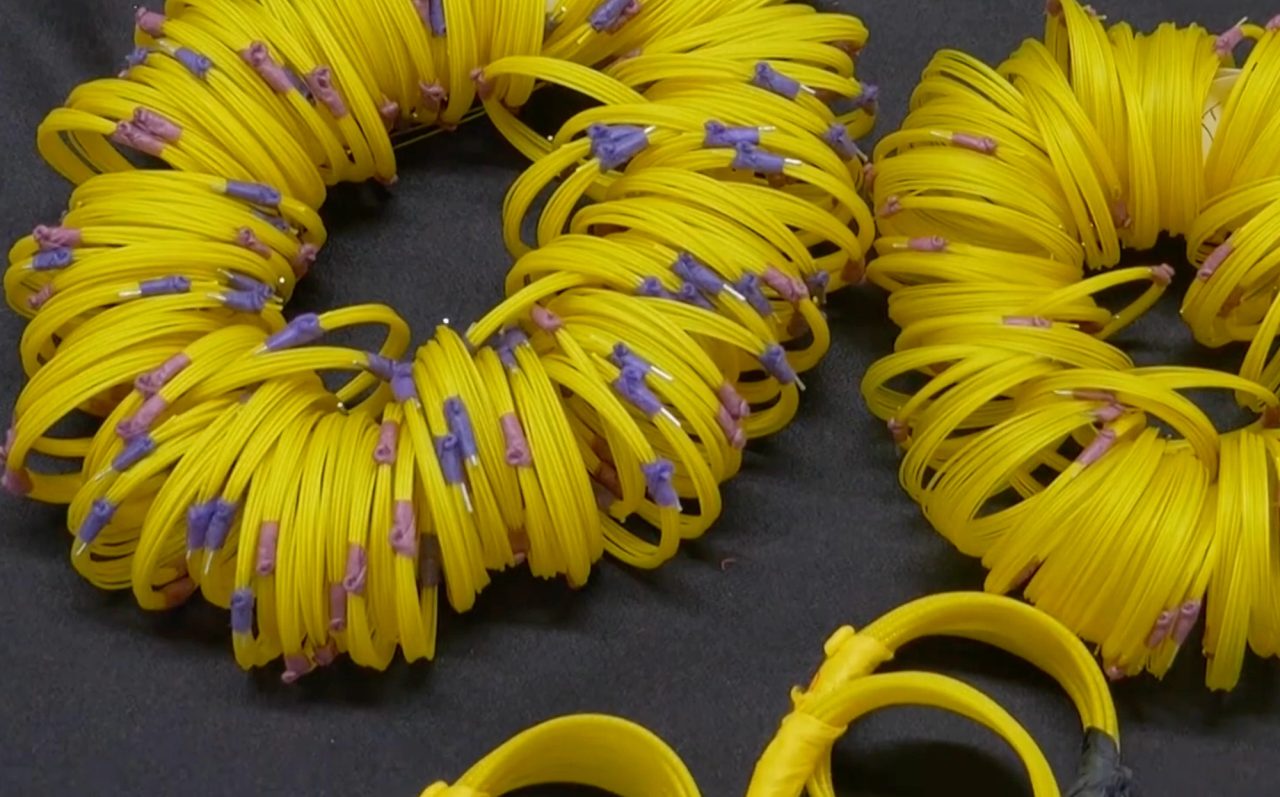
Then dyeing, traditionally yellow with turmeric for shamisen strings.
Thinly shaved rice cake is boiled down and strained, and the strings are simmered in the paste so the twisted threads bond to each other.
They are hung under tension and left to air dry.
Near the end, someone runs each finished string through their fingers.
Small knots survive the whole process and the eye misses them, and a knot too small to see will catch under a player's finger in the middle of a performance.
The last step is a coat of paste.
Too thin and it peels and the tone loses tension.
Too thick and the string is strong but will not resonate.
Four hundred strings for one country's music
What comes out of that process is not one product.
This one workshop: Marusan Hashimoto makes more than four hundred varieties, sorted by instrument, thickness, material and grade.
Shamisen strings alone split by tradition, since nagauta, jiuta, tokiwazu, minyo, Tsugaru and gidayu each ask for a different balance of strength and tone.
There used to be a reason for that range beyond instrument type.
String makers were scattered across the country, and each region's music was built on the strings made near it.
Kamigata favored a bright, unhurried sound. Kanto wanted something harder and more solid.
When a maker closed, the sound went with it, and the makers who survived had to learn to reproduce tones that were never theirs.
Marusan Hashimoto was founded in 1908, after Hashimoto Sannosuke traveled from Shiga to Osaka, learned the string-making technique behind the gidayu shamisen and came home to work with local silk.
The company still supplies close to all of the professional-grade gidayu strings used in bunraku puppet theater.
Gakki ito was designated a Shiga Prefecture Traditional Craft in 1987, and the production of raw thread for traditional instruments is recognized nationally as a selected conservation technique.
How the mulberry fields disappeared
Silk did not lose to a better string.
It lost to a food shortage.
Wartime and postwar policy turned mulberry fields into rice paddies and vegetable plots across Japan, and the silkworms went with them.
Polyester arrived into the gap and spread fast, because silk reacts to humidity and breaks.
More than 95 percent of koto strings sold in Japan today are polyester.
Marusan Hashimoto sits on both sides of that.
In 1960 it developed the industry's first nylon koto string and patented the method four years later.
The workshop that helped replace silk is the one still keeping it alive.
Where the strings go now
They still go to the Kabukiza in Tokyo and to bunraku in Osaka.
Occasionally they go somewhere stranger.
One five-stringed biwa survives anywhere in the world, kept in the Shosoin treasury in Nara, where it arrived along the Silk Road in the eighth century.
When the Imperial Household Agency commissioned an exact reproduction, the strings had to be made in Kinomoto.
Biwa strings are far thicker than the shamisen strings the workshop usually spins, so they built a 1.5 kilogram top for the job.
The strings took four months.
The longer arc is the one running the other direction.
Questions we get asked
Are silk strings better than nylon for shamisen?
For tone, most professional players prefer silk. For durability and stability in humidity, nylon and polyester are clearly better.
How long do silk shamisen strings last?
Less than synthetic strings, which is the main reason the market moved.
Silk is chosen for sound, not lifespan.
What is gakki ito?
Gakki ito means strings for traditional Japanese instruments. It is the name the craft was designated under in Shiga Prefecture in 1987.
Craft Chronicles reaches people who care about how things are actually made.
Sources
- www.youtube.com/watch?v=iwn0FB822xw
- www.youtube.com/watch?v=g9TP6h9pzE4
- www.youtube.com/watch?v=AlTSUyBCWmo
- www.youtube.com/watch?v=Z0uXUjWPZv4
- www.youtube.com/watch?v=FXnP6nQvMDQ
- www.youtube.com/watch?v=GUIy4jWsQc8
- www.marusan-hashimoto.com/product/
- nihonmono.jp/article/38095/
- g.kyoto-art.ac.jp/reports/1104/
- onsa.g.dgdg.jp/onsanews14-2-2.pdf
- ichikame.jp/pages/47/