EP.156 · Yame Wagome · Fukuoka
Yame Wagoma: The Fading Art of Fighting Tops
Crafted from dense oak with an iron point, Fukuoka’s Yame wagoma are traditional wooden tops built for battle, vivid color rings, and high-impact play.
A Spinning Top Made for Impact
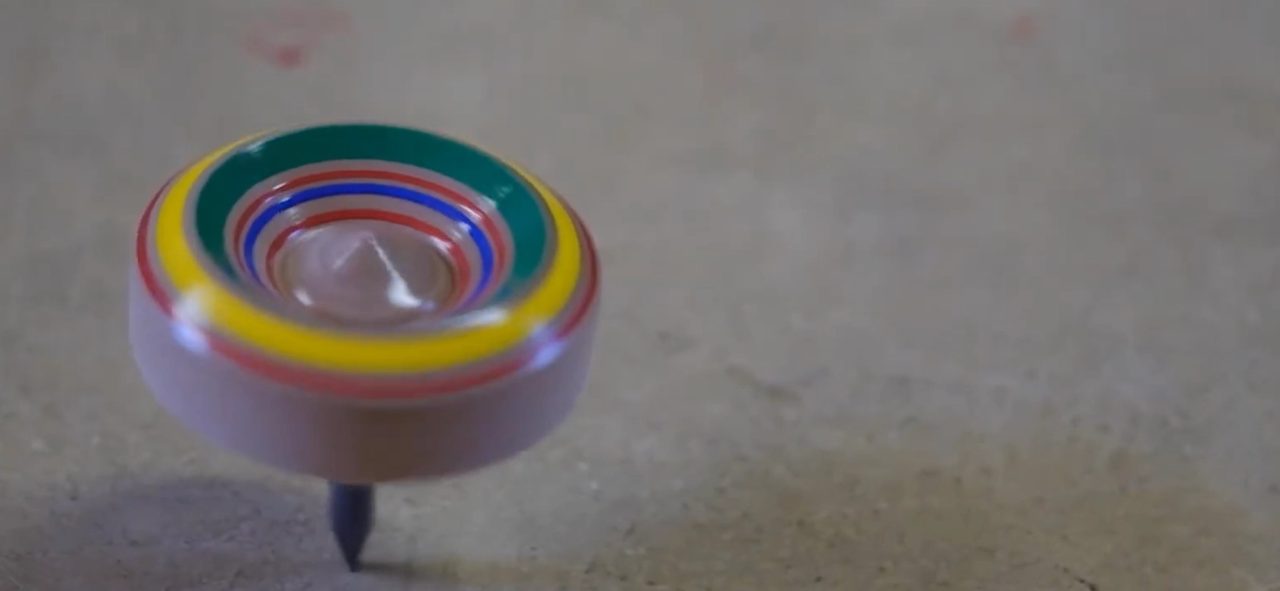
The bright rings of a Yame wagoma (八女和ごま) make it look festive, but its iron point reveals a more competitive purpose. These wooden tops were made not only to spin, but to collide.
In a traditional game known as kenka-goma (喧嘩ごま), or “fighting tops,” players throw their tops toward one another. The goal is to knock an opponent off balance while remaining upright and spinning.
Iron-tipped throwing tops developed across Kyushu, with different forms emerging in Hakata, Higo, Hirado, Sasebo, and other areas. The Yame form is distinguished by the pointed projection rising from its recessed upper surface. Known as the heso (ヘソ), or “navel,” it gives the top its unmistakable profile.
Yame wagoma is now recognized as a Fukuoka Prefecture Governor-Designated Specialty Craft.
From Courtly Object to Regional Toy
Spinning tops are believed to have reached Japan from the Asian continent through the Korean Peninsula before or during the Heian period. Initially associated with courtly rituals, they gradually became familiar toys.
By the Edo period, hand-spun and string-launched varieties had spread throughout Japan. Communities adapted them to local materials and styles of play, leading to the development of distinctive regional forms such as Yame wagoma.
Earlier Yame tops are said to have resembled the flattened bead of a Japanese abacus. Over time, the body became easier to grip and throw. Its upper surface was recessed while the center remained raised, producing the heso that defines the craft today.
The present form appears to have been established by around the mid-20th century. Few earlier examples survive because these were everyday toys subjected to hard use. They were worn down, split during games, discarded, or sometimes burned as scrap wood rather than preserved.
Shaped for a Clean Spin
The traditional material is mategashi (マテガシ), a dense oak chosen for its strength. Straight trees more than 30 years old are felled in winter, cut into manageable lengths, and dried for at least a year. Larger pieces may be seasoned for several years to prevent warping.
Once dry, the wood is shaped on a lathe. The recessed upper surface and central heso are then carved by hand, leaving subtle differences between individual tops.
After the body is smoothed, an iron point is driven into its underside. Its position must align precisely with the center; even a small imbalance can make the top wobble or shorten its spin.
Color is applied while the top rotates on a special lathe table. Two people touch separate brushes to the moving surface, creating vivid concentric rings. The speed of this process allows the finished object to remain accessible as a toy rather than becoming something intended only for display.
Keeping the Craft in Motion
Only one workshop in Yame now continues to make the region’s traditional form. Suitable mategashi has become harder to source, while the number of people able to produce its iron points has also declined. Fewer children now learn how to spin and throw the tops naturally from older players.
Instead of preserving the craft unchanged, its makers have found new ways to introduce it. Beginner-friendly versions use machine-cut spiral grooves that make the string easier to wrap. Coloring workshops invite visitors into the making process, while community competitions bring experienced players and newcomers together.
These gatherings also restore the way the game was traditionally passed down. Older children show younger players how to wind the string, position their hands, and control the throw. Skills develop through observation, repetition, and friendly competition.
Yame wagoma can be collected as a colorful piece of regional woodcraft or given as an auspicious object. Yet its character becomes clearest in motion. When the string is pulled and the top strikes the ground, it reconnects the material, technique, and shared play that shaped it.
Craft Chronicles reaches people who care about how things are actually made.
Sources
- www.youtube.com/watch?v=TD50cZHQ6fA
- www.youtube.com/watch?v=ouLmEH4WrMU
- www.youtube.com/watch?v=1cAS2eV_82I
- www.youtube.com/watch?v=8FQHjNAnG7M
- www.youtube.com/watch?v=suNhpDFHIkA
- www.pref.fukuoka.lg.jp/contents/gaiyou-dentoukougei.html
- www.city.yame.fukuoka.jp/soshiki/sangyou/55/56/dentoukougeoi/1455885078371.html
- www.crossroadfukuoka.jp/traditional-crafts/16728
- www.acros.or.jp/magazine/trad21.html
- yamegoma.work/
- catalog.lib.kyushu-u.ac.jp/opac_download_md/1650622/p067.pdf